
Incentive is a student-led non-profit that is changing the way financial literacy education is brought to the classroom. With extensive opportunities for high school students to take rigorous leadership positions within their community, Incentive gives these student educators a platform to make lasting change through financial education.
SEE Change spoke with co-founder Sathvik Vadlakunta, a junior at Davidson Academy in Reno, Nevada about what prompted him to start the nonprofit with fellow student Matthew Park, a senior at the Illinois Math and Science Academy in Aurora, Illinois. We discuss why financial literacy is so important, how this unique program is keeping students interested – and even having fun – and any lessons the co-founders have learned so far.
Why is financial literacy so important?
In seventh grade, I sat through what was supposed to be a financial literacy class. Of everything covered over that school year, all I retained was simply that “Certificates of Deposits are low risk”. That’s it. Not how to budget, not how credit works, not how to open a bank account, just one isolated fact that meant nothing to a twelve-year-old with no money to handle. The class was supposed to prepare me for financial adulthood. But instead, it gave me a perfect example of exactly what financial literacy education should never look like. The problem was never my attention span. The problem was that nobody made any of it feel like information I would actually need. Now that I am in high school with the knowledge and resources to do something about this issue, I started Incentive.
Across the country, proper financial literacy education has become tremendously inconsistent, making it hard to find reliable resources wherever you live. For example, currently, Nevada is one of the fastest-growing states in the country, yet it consistently ranks among the bottom 10 states for financial literacy education. For a state that calls itself the “silver state”, it is a striking contradiction that so few of its students are ever taught the foundational principles of managing this wealth. For students growing up in a state built on economic extremes, from the glittering wealth of Las Vegas to the more rugged, resource-driven Elko, understanding money isn’t just a life skill; it’s a survival skill.
The reality is that most Nevada students will graduate without ever learning basic financial principles like filing taxes, building credit, or even how to open a savings account. They’ll enter adulthood making financial decisions that encroach upon them for decades, prepped with nothing but guesswork. From having one of the highest household debt rates to youth unemployment rates that consistently rank among the worst in the nation, the consequences within Nevada are alarming. However, these outcomes are not coincidental. They are the direct consequence of a systemic failure to provide young students with the financial knowledge they deserve. The consistent consequences only highlight an ever-growing gap that can only be bridged through education.
What is rarely acknowledged, however, is that students are not simply victims of the gap, but rather the most powerful force capable of closing it.
When students advocate for financial literacy within their schools, teachers and administrators respond differently. Even a single student empowering the rest of their school carries an authority that no policy brief or administrator can replicate, simply because these students embody both the problem and the solution simultaneously. Additionally, youth voice reaches communities that institutions like schools simply don’t control. A junior explaining compound interest to a sophomore in a language they both understand is worth more than any textbook can offer. Nevada’s next generation doesn’t just deserve financial literacy education. They deserve to be the ones who make it happen.


How does Incentive work?
Incentive is a student-led nonprofit that is changing the way financial literacy education is brought to the classroom. With extensive opportunities for high school students to take rigorous leadership positions within their community, incentive gives these student educators a platform to make a lasting change in their community.
Students are able to contribute to Incentive’s mission no matter how old they are. Even if you’re a young student who knows nothing about financial literacy, simply reaching out to your nearest Incentive chapter for a financial literacy workshop is the best thing you can do. Conversely, students in high school have the ability to start their own chapters within their local area/school to direct workshops, events, host fundraisers, and run community drives to raise awareness about financial literacy. By starting a chapter, students become active voices in their community, becoming a driver of free, and quality financial literacy education. To start a chapter, students can either fill out a quick form or contact our instagram or tik tok at “@incentive.finance”.
But also, the website, incentivefinance.org, contains premade financial literacy lessons that gamify each topic in the personal finance world. Students work through bite-sized lessons on budgeting, saving, credit, and investing, earning points, badges, and level-ups as they go, so progress feels like a game instead of a chore. On top of this, the website features interactive tools like a retirement calculator and a loan calculator, meaning that students are able to look into the future and visualize their future fiscality.
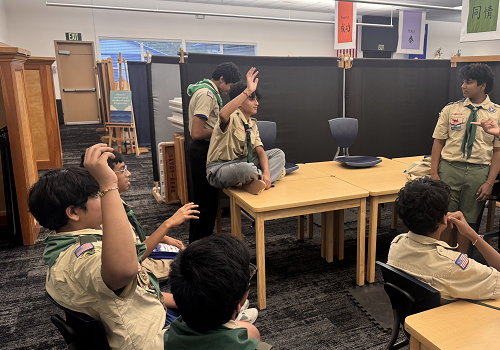
Financial literacy workshop to Boy Scout’s Troop 15 in Reno, Nevada. The workshop was hosted by Incentive’s Galena High School chapter.
How would you define its impact so far?
Incentive originally started out as a grassroots project in February. However, after getting more support for the cause it became a registered non-profit in early April. Since then, we have set up chapters in 6 different states with over 30 volunteers. In the future, Incentive hopes to branch out into collegiate and international chapters. Across social media, news features, and local outreach, Incentive has generated close to million impressions.
Instead of obsolete, old, and tiring systems that don’t give students what they need, Incentive brings a spark of youth into financial education for everyone. Every high schooler who joins Incentive walks away with more than community service hours. They develop the ability to communicate complex ideas clearly, lead a classroom with confidence, take initiative, and build something that has real impact in their community.
But at the same time, the same students being taught financial literacy have the opportunity to return the gesture and keep the cycle going. incentive isn’t just a “one-off” project, it’s a movement of student leaders and educators ready to make that next step to ensure financial freedom for everyone. From budgeting basics to investing fundamentals, our tools are designed to make learning about money feel approachable and exciting.
What lessons have you learned from running this initiative?
Often time, mentors, or other nonprofit founders would tell us to be ambitious with our goals. However, when it came to putting that “reach for the stars” mentality into action, we quickly noticed how our ideas would derail themselves and we would spend more time justifying what we were doing rather than just making an impact; there’s a difference between being ambitious without a plan and having a plan to be ambitious, and we spent too much time stuck on the first. Altering the advice given to us was what made us become consistent in our efforts, as we observed that smaller, manageable tasks allowed us to grow into what we are today.
If you want to reach Incentive:
incentivefinanceinfo@gmail.com
Instagram: incentive.finance
Website: incentivefinance.org