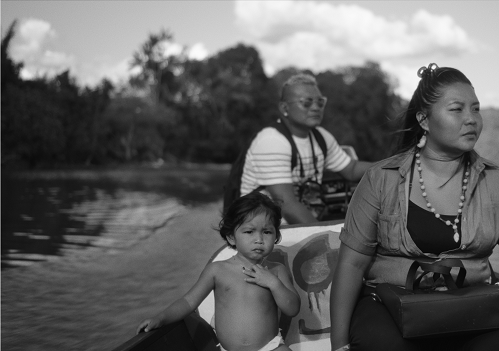
They say a picture is worth a thousand words. The idiom resonated strongly upon watching the film Parasisi, a documentary that premiered at the Hot Docs Film Festival in Toronto. The opening scene, in particular, laid bare the challenges – past, present and future – facing the Wayana people, without even one utterance. We watch a man and his child swimming, bathing, in open water under the backdrop of the Amazon rainforest. What would have been an idyllic scene is shattered a moment later when a work boat “belches” across their path, its work-weary passengers offering nary a glance at the swimmers. Father and daughter stop their play and stare forlornly at the passing intrusion. You don’t need any words to know that this was a regular occurrence and that, while unwelcome, it was tolerated practice.
Along the Lawa River, which establishes the border between Suriname and French Guyana, you can find the Wayana people. Though once a larger community, the gold rush of 1885 introduced disease to these parts, causing their numbers to dwindle. Today 2500 Wayana remain in their indigenous homes, but the impact of intruders, outsiders – who they refer to as “parasisi” – remains a palpable and destructive presence.
The most obvious intrusion can be seen by those mining for gold, a process that contaminates the environment with mercury. In one scene, the sound of machinery and vibrations of industry rattle the lush, peaceful environment, the auditory dissonance echoing through the trees. We witness experts testing for mercury (in the air, water, mothers, babies) and doctors warning the community to be careful of the fish they consume. Of course, doctors (also considered parasisi) speak in a foreign language the mothers don’t fully understand; information is translated whenever possible.
Then there are the missionaries who try to introduce new traditions and belief systems, with neither permission nor deference to the traditional practice of the Wayana. It seems contamination of thought and action are as rampant as mercury poisoning. Shot in black and white, Parasisi quietly follows the Wayana (no talking heads in this documentary) go about their lives, all while tolerating, adapting and balancing tradition with intrusion.
I spoke with filmmakers Zaïde Bil and Sébastien Segers about the film, the Wayana’s struggle in the face of externalities, and what we can all learn from their story.
What inspired you to make this film? Why was it important to tell – and why now?
Zaïde: This is our second film shot in Suriname. We were drawn to the subject after noticing how little is known and told about the indigenous people, even in Suriname itself, let alone in the rest of the world. Most people don’t even know the country or know where it is. As a former Dutch colony and the country where my mother grew up, I have a special connection with it. The title of the film is Parasisi, a Wayana word for “parasite” or “intruder”. It is a portrait of life in an indigenous community on the border of Suriname and French Guyana, where the presence of intruders leave their marks in both visible and invisible ways.
Sébastien: The main intrusion we observe is illegal gold mining, which poisons the land and water with mercury. It shows how the same logic of extraction that existed for centuries is still very much alive today, and still threatening the people who live there. We wanted to show how these quiet forms of violence work their way into the everyday lives of families living along the river. The film is really a reflection on how colonial histories still exist and how they leave traces in the land and in people’s bodies. It’s a story of Indigenous emancipation in modern times and a reminder that as a broader society, we are still very much involved in the colonial activities of the past.
The film is beautifully shot in black and white. What was behind that cinematic choice?
Sébastien: The choice to shoot in black and white came from a very specific moment during our first research trip. We had been filming on the river that day. The equatorial sun is very hard and direct, so I chose to use a setting for easier focusing, which turns the image in black and white. When we reviewed the footage that evening, we noticed what the monochrome had done to the water: it no longer looked like water. It looked like the quicksilver colour of mercury. We realised the very medium of the image had become the substance at the centre of the story. It’s that specific moment we decided this film needed to be black and white.
Zaïde: There’s also a historical argument to make for the choice. Most of what Western audiences know about indigenous people comes from old black and white photographs and films made by missionaries and explorers (like Nanook of The North, for example). So filming an indigenous community in black and white today automatically calls up that history. We did it on purpose, but with the intention of pushing back against that image and reclaiming it as something that’s made on their own terms, as a form of visual argument with the past.
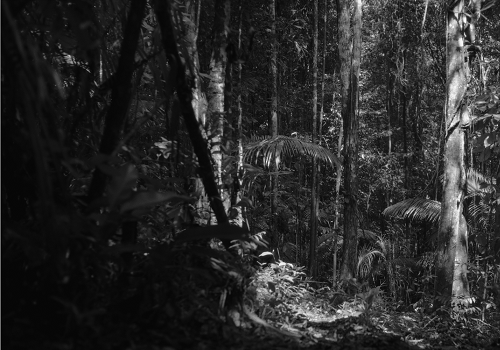
Suriname is considered ‘the world’s greenest country’, with 90% of its territory covered by the Amazon forest. But every year small-scale gold mining releases 50,000 to 80,000 kilograms of mercury into the environment
Has there been any pushback by the Wayana to the parasisi? It seems there’s a lot of acceptance but no conflict.
Zaïde: The Wayana are a very kind people, even maybe a little shy and hesitant. They are very welcoming, even for people that might not have the best intentions. During the production, the working title for this film has been ‘adapt or perish’. This is a creed the Wayana really live by. It’s part of the Wayana way of life to adapt to new situations and accept change. Their tolerance is notable, but also makes it easier for people with bad intentions to take advantage of it. There is pushback from organisations like Mulokot Foundation, which was created by leaders Jupta Itoewaki and Ipomadi Pelenapin, who’s the chief of the village where we filmed. Their organisation has been relentlessly trying to record, measure and prove to the government that their territories are being poisoned and invaded by illegal gold mining. They are really trying their best to do what they can: they recently spoke at the general assembly of the UN to generate urgency towards illegal gold mining and indigenous rights.
Sébastien: The influence of the church is much harder to pushback, since it’s been so well infiltrated in daily life of the Wayana for decades. Some of them have welcomed the new religion with open arms, because it brought them medicine and modernity, which made many Wayana converted to Christianity. But there is also still a big, more silent group of Wayana who aren’t Christians and who still try to protect and conserve the old traditions and rituals. But as with most colonial projects all over the world, religion was used as a way to subjugate people’s hearts, which makes it very hard to make them realize this very religion is also suppressing their indigenous identities.
Is the mercury poisoning a danger they take seriously? Have you witnessed any change to their way of life in response to the toxins?
Zaïde: The message is taken very seriously by the Wayana and in fact, they have known for decades that they are slowly being poisoned. They don’t need outsiders to come in and tell them they are in danger. They know. The problem is not that they don’t take the threat seriously, it’s that they don’t have a lot of options regarding their nutrition, as they have been living from what the river provides them for centuries. If they aren’t allowed to eat the fish anymore, if they aren’t allowed to hunt in the protected forest anymore, if even their farming plots are increasingly being threatened by mercury poisoning, what options do they have left? The solution is simple: give the Wayana and other indigenous people territorial rights to their ancestral lands, then they have the power to decide who is welcome and who isn’t.
Sébastien: I think it’s time we flip that question over: what the Wayana need is outsiders to finally take the issue seriously and put pressure on the governments and companies that are responsible for this catastrophe. Small scale gold mining is the largest single source of anthropogenic mercury pollution in the world, contributing almost 40% of all mercury that enters the atmosphere as a result of human activity. That alone is an incredible number and really asks for urgent response. We should really take a stance towards gold and how it is extracted. We live in a society where it is still totally accepted to wear, buy or even trade gold, and we don’t even realize or care where it comes from and who or what it might damage.
Are there any outside efforts to reduce the “infiltration”? For example, to limit gold mining?
Sébastien: The problem is that Suriname’s economy is largely dependent on extractive industries, especially the gold mining industry. It accounts for approximately 85% of Suriname’s exports and over 30% of government revenue. We are talking about a country that has battled the aftermath of colonization since 1975, the year they gained their independence from The Netherlands. It suffered for decades under the civil war, their economy is very fragile and corruption is still very widely spread all the way to the top of politics. In the meantime, the natural resources of Suriname draw the interest of global superpowers like China, who profit from the instability of the country.
Zaïde: In French Guyana the situation is slightly different: this is still considered French territory, making it a colony of France. There is more pushback against illegal gold mining. The army actively hunts the miners, destroying their camps, arresting them if they can. But most of the time they just flee across the river into Suriname, where they cannot be prosecuted by the French, making it an endless cat-and-mouse game that the French government can’t possibly win without the help of the Surinamese government.
What were you hoping this film will inspire in its viewers?
Zaïde: Our main goal with this film is to create a different view on gold. It’s something people don’t think of when they buy their beautiful engagement rings or purchase gold as trading stocks. The effects that gold mining has on our biodiversity and the vulnerable communities worldwide are barely known, but they are devastating. We already do this with other products we buy from the global South, like fair trade labels for coffee, chocolate, bananas, etc. Why can’t we have a fair-trade label for gold?
Sébastien: If gold were to be evaluated according to the environmental damage and social disruption it causes, it would never be as valuable as it is considered today. We should totally reimagine what’s valuable and what isn’t. Also something worth mentioning is that Canada has long been involved in gold mining in Suriname. The Rosebel mine was operated by Canadian company IAMGOLD for nearly two decades before being sold to Chinese mining giant Zijin in 2023. Canadian exploration companies are still active in the country today. That history of extraction, and the responsibility that comes with it, makes showing this film at Hot Docs feel especially relevant.